Research · iPoker Network · NLH / Spin / Speed Poker
Bet365 Poker Bots: A Complete Technical Reference
An independent reference on what poker AI actually looks like inside Bet365 Poker — a Playtech-licensed iPoker Network skin run by the UK gambling group built by Denise Coates. Written for developers, researchers, and players who want the real architecture: shared network anti-cheat, operator-level KYC, mid-tier liquidity, and the reasons the serious poker-AI money is pointed at other rooms entirely. No sales pitch, no magic.
Questions? Reach the team on Telegram

Bet365 Poker in one page
Bet365 — the gambling group built from a Stoke-on-Trent caravan park in 2000 — runs one of the larger online sportsbook and casino operations in regulated Europe. Bet365 Poker sits inside that group as a smaller revenue line, with the poker product white-labelled from Playtech's iPoker Network rather than built in-house. The legal operating entity is Hillside (UK Gaming) Ltd; the client is a re-skinned iPoker client; the liquidity is shared across iPoker skins.
That structure changes almost every interesting question about bots on the platform. The traffic a player sees on a Bet365 Poker table is network-wide, not operator-wide. The RNG is Playtech's. The anti-cheat that watches multi-account collusion and bot farms is Playtech's. Bet365 contributes a fraud and KYC team — built for the sportsbook side, where the money sits — and the operational decision to ban an account. Network and operator each cover roughly half of the detection picture.
From a product perspective Bet365 Poker offers what the iPoker schedule offers: NLH cash from €0.02/0.05 up through roughly €5/10, the Twister-branded Spin format at €1 to €25 buy-ins with random multipliers up to 1000x, Speed Poker (the iPoker fast-fold variant comparable to Rush & Cash or Zoom), and a thin MTT schedule. UK and several EU markets are served; US has been locked out since the Black Friday era of 2011, as expected for a Hillside-licensed operator.
The iPoker Network architecture
iPoker has been around since 2004. Playtech acquired it in 2007 and has run it as a B2B liquidity platform since — operators license a skin, brand it, and share the player pool. The Bet365 skin is one of the better-known active skins; Coral, Betfair, Titan Poker, Betsson historically, and a long tail of regional operators sit on the same network. The historical roster matters because it shapes the detection question: a bot that runs on Bet365 is observed by Playtech across every skin in the network, not just Bet365. Players comparing networks often line iPoker up against the Chico Network and the GGNetwork; the relevant difference for bot work is how widely each network joins behavioural data.
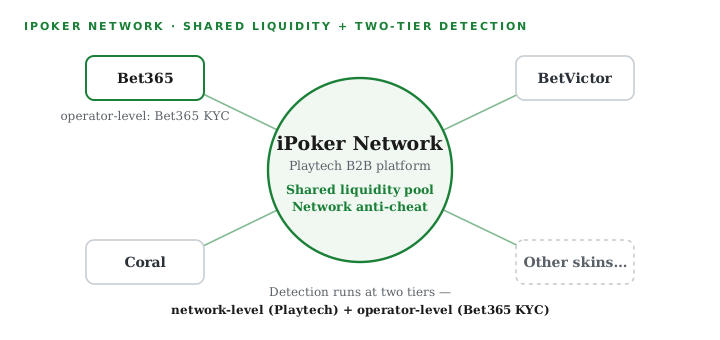
Three architectural points are worth pulling out for an engineering audience:
- Shared anti-cheat at the network level
- Playtech runs the behavioural-fingerprint pipeline, the statistical play-pattern analysis, and the collusion graph across the whole network. The data joins on Playtech's internal player IDs, which span skins — a player who registers separately at Bet365 and Coral with the same device and KYC document is still one node in the graph.
- RNG and audit at the network level
- The shuffle and the audit chain run on Playtech infrastructure. eCOGRA historically attested the iPoker RNG; current attestations are licensed-jurisdiction-specific (UK Gambling Commission, Isle of Man, Malta, Romania, Spain). The audit does not prove security; it confirms that the audit happened and that the system in production matches the one attested.
- Operator-level fraud and KYC
- Each skin runs its own customer-facing risk team. Bet365's is sportsbook-grade — large, well-funded, used to thinking about chargebacks, identity theft, and arbitrage. The poker-specific knowledge is thinner than at a pure poker operator, but the fraud machinery sitting underneath is heavier than what a pure poker operator typically affords. Operations are run from licensed hubs rather than the offshore Panama or Curacao setups that grey-market rooms historically used.
The practical consequence for a bot author is that the detection signal is more diffuse than at a single-skin operator. A play-pattern outlier that survives Bet365's review queue can still be flagged by Playtech weeks later when the same fingerprint appears on a sister skin. The catch rate is slower and less consistent than at GGPoker — but it is not zero, and the volume across skins gives the network a larger reference distribution than any individual skin would.
What we mean by "poker bot" in 2026
The phrase gets used so loosely in public discussion that almost every conversation starts on the wrong foot. For the purposes of this reference, a poker bot is software that takes visible game state as input — your seat's hole cards, the community cards, the action sequence, stacks and positions — and emits an action under a real-time latency constraint. A poker bot does not read network packets. It does not know opponent hole cards before showdown. It does not predict the deck. Everything it does, a human could do with the same information; the human would just be slower, less consistent, and unable to play eighteen tables at once.
The interesting work sits in three layers underneath that definition:
- A solver-anchored baseline compiles CFR-derived strategies — Pluribus-style for multiway 6-max NLH, PioSolver or GTO+ for heads-up trees, MonkerSolver for the parts of PLO anyone has the patience to solve — into compressed action-frequency tables keyed on bucketed game states.
- An online opponent model updates lightweight statistics over the session, since long-horizon HUD data is unreliable across iPoker's skin rotation and external HUDs are blocked.
- A policy combiner decides how far to deviate from the baseline given the current opponent estimate, with detection-aware noise on the output distribution.
| Format | Stack depth | State complexity | Solver coverage | Difficulty |
|---|---|---|---|---|
| NLH 6-max cash | 100bb | Medium | Strong (Pio, GTO+) | Low — exploit layer dominates |
| NLH full-ring cash | 100bb | High (multiway) | Partial (Monker) | Medium — multiway trees blow up |
| Speed Poker (fast-fold) | 100bb | Medium | Same as 6-max | Low math; seat rotation breaks the opponent model |
| Twister (Spin) €1–25 | 10bb start | Medium | Strong (push-fold) | Medium — multiplier variance dominates EV |
| MTT (small schedule) | Variable | Very high (ICM) | Patchy | High — open research, too thin to be primary |
The reality of "Bet365 Poker hacks"
A useful first step is to refuse to treat "Bet365 Poker hack" as one thing. Search-intent analysis on the phrase reveals at least five different products grouped under the same name. Four of the five are architecturally closed or economically nonsensical as a public product. The fifth is where the work actually happens.
| Category | What it claims | Feasibility |
|---|---|---|
| Server exploit | Read cards from the operator DB | No — an RCE against Playtech is worth six to seven figures in disclosure, not a $99 download |
| RNG break | Predict the next board card | No — modern CSPRNGs are not invertible at the rate poker exposes them |
| Hole-card peek | See opponent cards live | No — card transmission is server-authoritative and encrypted at multiple layers |
| Data-mined HUD | Long-horizon opponent stats | Largely closed — ToS bans third-party HUDs and the client blocks process injection |
| AI decision engine | Better play given visible state | Yes — the only category with real engineering behind it |
The RNG claim has the cleanest takedown. The modern shuffle uses a cryptographically secure pseudo-random number generator seeded from multiple entropy sources, committed server-side before any card information leaves the server. A player observes shuffle outputs at roughly four bits per second; the CSPRNG produces on the order of a billion bits per second. You cannot reconstruct a key from a one-in-250-million-attenuated signal. The 2013 iPoker shuffle incident was a specific implementation bug, found and fixed over a decade ago — not a generic flaw in the current shuffler.
"Hole-card hacks" trace back to the UltimateBet and Absolute Poker scandals of 2007–2008. Those were not external research findings turned into retail products. They were internal cheating schemes by operator staff abusing administrative tooling, caught by statistical analysis of suspicious hand histories rather than by anyone offering to share access. The parsimony test is simple: would Hillside (UK Gaming) Ltd jeopardise its UK and EU licences, with a multi-hundred-million-pound revenue line at risk and executives exposed to criminal liability, to sell a backdoor through a Telegram channel? The answer is the answer.
How detection actually works on iPoker
Detection is a stack of asynchronous signals weighted into a per-account score. No single signal triggers a ban; a score accumulates and crosses an escalation threshold tuned to a false-positive budget. The novelty at iPoker is the network-versus-operator split: some layers run at Playtech and see every skin, some run at Bet365 and see only Bet365 traffic plus KYC and payment context.
- Layer 1 — Behavioural fingerprinting (Playtech)
- Client telemetry on input timing, mouse-path geometry on desktop, touch dwell and pressure on mobile, action-confirmation latency, idle behaviour between hands. Cheap to compute, runs continuously, joins on Playtech's player ID across all skins, and bites naive implementations hardest.
- Layer 2 — Statistical play-pattern analysis (Playtech)
- Per-account distributional analysis on VPIP, PFR, 3-bet by position, fold-to-cbet by board texture, bet-sizing histograms, all-in equity at showdown. Network-scale data joins make this stronger at iPoker than the user-facing skin volume suggests. Pure-GTO output stands out paradoxically faster than a noisier strong-human strategy.
- Layer 3 — Anti-collusion graph (Playtech)
- Account graph joined by IP, device fingerprint, deposit method, KYC document, table co-occurrence. Catches multi-accounting and chip dumping; bot farms appear here when run under shared infrastructure.
- Layer 4 — Operator fraud, KYC, and human review (Bet365)
- Sportsbook-grade fraud machinery — payment-pattern anomalies, ID verification, source-of-funds checks at regulator thresholds. Final ban decisions on mixed signals are taken here, often with input from Playtech's analysts.
The visible result is a long lag between a bot's first session and the eventual ban — typically two to nine months at iPoker, with a median around three to four months, anchored on when a triggering event (usually a large withdrawal) pulls the account into the review queue. The mathematical signal is usually present months before the human review is queued.
Action-timing fingerprints
The most-discussed and most-poorly-implemented signal in the stack. A naive bot emits actions at a fixed latency or with uniform noise around a mean. Both are immediately distinguishable from human play. Human action-timing distributions are roughly log-normal, with state-dependent location parameters and heavy right tails. A snap-fold of obvious garbage lands in 600–1200 ms. A routine c-bet on a clean board sits at 1.5–4 seconds. A boundary river decision can take 5–30 seconds, with a separate distraction tail of 8–25 second pauses uncorrelated with game state. The shape of this distribution is the fingerprint; matching only its mean or variance does not match the shape.
def sample_action_delay(difficulty, action_type):
    mu = MU_BASE[action_type] + 0.7 * difficulty
    sigma = 0.35 + 0.55 * difficulty
    delay = lognormvariate(mu, sigma)
    if random() < 0.03:          # distraction tail
        delay += uniform(8, 25)
    return max(0.25, delay)       # humans cannot react in < 250ms
The example is schematic. Production systems condition on stack depth, opponent action sequence, position, multiway versus heads-up, and a per-session alertness parameter that drifts down to mimic fatigue. The correct behaviour is not "add noise" — it is "draw from a distribution whose shape matches the population, conditioned on game state."
Cheating vectors and how bans are structured
Each prohibited category routes through a different signal stack. Collusion and chip dumping carry the highest operator priority because regulators care about them — the UKGC and MGA both require licensees to demonstrate active anti-collusion measures. Botting and real-time assistance (RTA) sit slightly below. Multi-accounting is the easiest to catch because the KYC and payment graph closes it cleanly. External HUDs trigger on client-side process detection. Ghosting is small-volume but spikes around iPoker's larger tournament series.
The visible enforcement sequence from outside, in order:
- Quiet flag. The account moves into a higher-scrutiny bucket. No visible change. Telemetry continues.
- Soft restriction. Withdrawal limits drop, KYC re-verification requested, bonus eligibility quietly removed.
- Structured interview. Bet365 support requests clarifying information about play style, schedule, and software in use. Answers are matched against the play-pattern model.
- Confiscation and closure. Winnings voided, balance held, account closed. UK customers have recourse through the Independent Betting Adjudication Service (IBAS), which lengthens the timeline.
The standard mistake is to treat detection as a feature checklist — add latency noise, vary touch coordinates, randomise schedule. Detection is an adversarial classifier. The bot's task is to produce a behaviour distribution the classifier cannot separate from the population distribution while preserving EV. The formal frame dates to Dalvi et al. (2004) and Lowd & Meek (2005); at iPoker it extends to two stacked classifiers, network-side and operator-side, with different decision boundaries.
Where the real engineering questions are
Five threads that are genuinely open in the iPoker context:
- Cross-skin behavioural-fingerprint portability. How much variance a single account's fingerprint can carry across sessions before the cross-skin classifier flags it.
- Online opponent modelling under skin rotation. External HUDs are blocked; the compromise is online estimation, and convergence under thin volume is harder than at higher-traffic operators.
- Twister / Spin engine economics. Multiplier variance dominates the EV signal over tens of thousands of games; whether opponent modelling has any role versus a pure push-fold engine with multiplier-aware ICM.
- Detection-aware selection under split classifiers. Two classifiers stacked, with different decision boundaries; the right formal frame is multi-classifier adversarial selection, where the literature thins out fast.
- Where to point engineering effort. The EV-per-engineering-hour curve peaks at GGPoker, not Bet365. iPoker is a secondary or development target; the interesting questions here are network-level rather than operator-specific.
Frequently asked questions
Is there a Bet365 Poker bot for sale?
Some commercial poker AI projects claim iPoker Network support, which by extension covers Bet365 Poker. Quality varies widely. Any bot marketing iPoker support is built on a shared client-automation layer across all skins; the math underneath is whatever solver and opponent-model code the team has, mostly developed against deeper liquidity at GGPoker and ported. Most teams that take poker AI seriously do not list Bet365 as a primary target.
Can a bot built for PokerStars work on Bet365?
No. The clients, protocols, UI layouts, and behavioural-telemetry surfaces all differ. A PokerStars bot can share solver and opponent-model code — those layers are platform-agnostic — but the UI automation layer is fully platform-specific and accounts for a large share of the engineering effort in any production poker AI.
Is Bet365 Poker still good for AI grinding in 2026?
Marginal. Liquidity sits at mid-tier — fine for development and as a secondary site, not strong enough to be a primary income line. The reasons to point a stack at Bet365 are a softer low-mid-stakes population (sportsbook cross-pollination keeps fish density reasonable) and diversification of account risk. The reason not to is that cross-skin observation is genuinely effective and accounts have shorter expected lifetimes.
Can I use a HUD like Holdem Manager or PokerTracker on Bet365 Poker?
Network-side ToS prohibits third-party HUDs and overlays across all iPoker skins. Enforcement is variable but real — the client performs process detection at startup and during play. Do not assume HUD use is safe even where it has worked before. Most modern poker AI work assumes no HUD support and falls back to online opponent modelling.
What stakes are bot-viable on Bet365 Poker after rake?
iPoker rake on NLH cash sits at 5–7% at low stakes, dropping to roughly 3–4% at mid-stakes, with some rakeback through VIP programmes. NL25 to NL100 is the sweet spot for cash: below that the rake share eats too much, above that the regular population grows aware of solver play fast. Twister is mathematically positive at €5–10 buy-ins given enough volume, with very high variance.
Bet365 vs GGPoker for a serious bot project?
GGPoker, by a wide margin, for any project where bot revenue is the primary metric: higher liquidity, rake structure that supports mid-stakes solver play, a softer recreational population, larger MTT pools. GGPoker also has the more sophisticated detection stack, but the EV-per-engineering-hour still comes out ahead. Bet365 / iPoker makes sense as a secondary or development site where account-loss cost is lower.
What is the difference between a GTO solver and a real-time poker bot?
A solver — PioSolver, GTO+, MonkerSolver — computes a near-equilibrium strategy for a game tree offline, iterating a CFR variant to convergence; the output is a large lookup table of action frequencies. A real-time bot queries that table as a baseline under tight latency, overlays an online opponent model that biases toward exploitative deviation, and adds detection-aware noise. The solver is the theory book; the bot is the player.